
Review · CHANIA OLD TOWN
Chania old town and around private tour (price per group of 6)
Chania Old Town has a way of grabbing you fast, and this private tour is built to help you actually use that time. You start on the west side of the old town, then move through the Venetian harbor area and on to key sights around Souda and the hills. It’s a guided day with real walking, plus moments to wander on your own.
I like two things most: the private format (your group sets the pace, not a bus schedule), and the mix of stops that go beyond postcard views. With guides like George, Petros, Elsa, Zoe, and Peter (names that show up again and again), you get both context and practical tips for what to see, what to skip, and where to eat. The only potential drawback is that this is not a sit-and-watch tour—expect uneven streets, stairs in places, and some stops are brief photo-and-fact moments.
In This Review
- A few quick things to know before you go
- 5 highlights you’ll feel the moment you arrive
- Price and value for a private group of 6
- Pickup, meeting points, and how the day starts
- Entering Chania Old Town from Talos Square (and why that west edge helps)
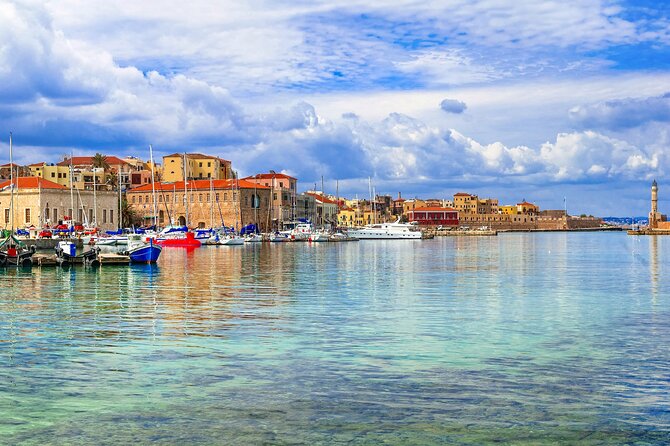
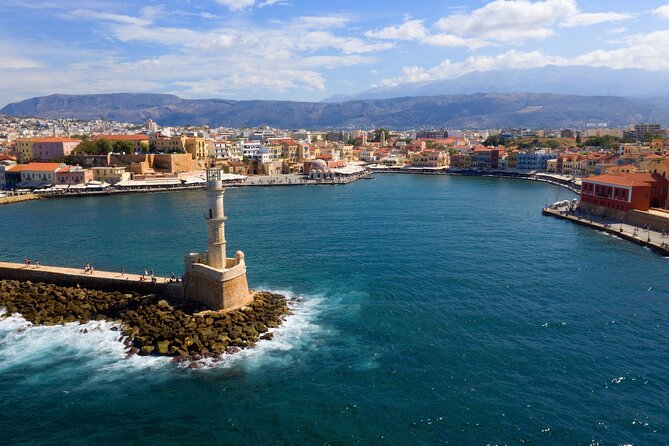
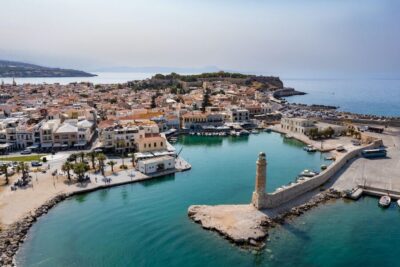
- Old Venetian Harbor and the lighthouse pier: the view that earns the effort
- Firka Fortress and Maritime Museum: a compact history stop
- Venetian Neoria shipyards: why you won’t enter (and still should stop)
- Minoan Palace ruins at Kasteli hill: the ancient layer under the city
- Souda port drive plus WWII cemetery and the views you’ll remember
- Venizelos Graves: a park viewpoint that caps the day nicely
- Lunch, tastings, and how to keep the day relaxed
- The guide factor: what George, Petros, Elsa, Zoe, and Peter bring
- The one thing to watch: walking, timing, and brief stops
- Should you book this Chania private tour?
- FAQ
- How many people is this private tour for?
- What’s the tour duration?
- Where do we get picked up?
- Is the tour in English?
- Are entrance tickets included?
- Does lunch cost extra?
- Are there optional add-ons?
- What happens if the weather is bad?
A few quick things to know before you go
- Private group of up to 6 with pickup and drop-off around Chania (including Souda port)
- English guide with mobile ticket
- Walk time in the old town plus short scenic stops
- Most sights listed here have free entry, while the Firka Fortress museum admission is included
- Departure window is 7:00 AM to 5:00 PM, and the day depends on good weather
Keep wandering the Chania old town and harbour
- Walking “Food tasting tour” in the town of Chania
★ 5.0 · 297 reviews - Chania Town: Glass-Bottom Boat Cruise to Thodorou & Lazareta
★ 4.8 · 285 reviews - The 7 Villages of Apokoronas Tour – Explore East Chania Mainland
★ 5.0 · 178 reviews - Chania Old Port:Luxury Sunset Catamaran Cruise with Prosecco
★ 4.9 · 177 reviews
5 highlights you’ll feel the moment you arrive
- Talos Square start on the west edge of Old Town: it’s often more lived-in than the busiest lanes.
- Firkas Fortress story: Venetian defense, Ottoman-era military use, prison history, and the 1913 Greek flag moment.
- Chania Lighthouse history: 1864 structure, with older Venetian and Egyptian-era influences, even if you can’t enter it.
- Souda Bay War Cemetery views: WWII history with sweeping scenery toward the bay and the White Mountains.
- A private guide who adjusts: if your group moves slower, the route can be managed better than on big-group tours.
Price and value for a private group of 6
This tour lists a price of $567.19 per group for up to 6 people, which is usually the key question: is it worth paying for privacy?
Here’s the practical math. If you’re traveling as a small-to-mid group (family, friends, or a cruise group that stays together), the cost often ends up in the same neighborhood as multiple seats on a group tour—but with an extra advantage: you’re not stuck in a single-file pace through Chania.
Also, this day isn’t just “drive and drop.” You get air-conditioned private transportation plus guided services, and you’ll spend time walking in the old town and visiting several distinct areas: the harbor, the lighthouse zone, Firka Fortress, shipyard remnants, Minoan ruins, and then the Souda area. For a place where the streets can tangle you up quickly, having someone show you the right turns saves energy (and time).
The price does come with options that can add cost. Lunch is listed as an optional €25 per person at a local restaurant. There’s also optional wine tasting, and optional “extra time” add-ons for mountain or beach stops with lunch. If you keep the day focused on the main itinerary, you’ll likely keep costs predictable.
Pickup, meeting points, and how the day starts
The tour runs between 7:00 AM and 5:00 PM, and pickup/drop-off is flexible within about 10 km (6 miles) around Chania old town. You can meet at Souda port, your accommodation, or another convenient location in that radius.
Why that matters: if you’re on a cruise, you can lose time to shuttles and crowds. A private pickup helps you use your morning instead of waiting around. In the past, guides also talk about departing early to dodge traffic, heat, and day-trippers, which is a smart move in Crete—especially when you’re walking.
You’ll receive a mobile ticket, and the tour is offered in English.
One more practical note: the tour requires good weather. If the weather doesn’t cooperate, you’re offered another date or a full refund. When you book, check the forecast for Chania and be ready for a “soft plan.” This is an outdoor walking day.
Entering Chania Old Town from Talos Square (and why that west edge helps)
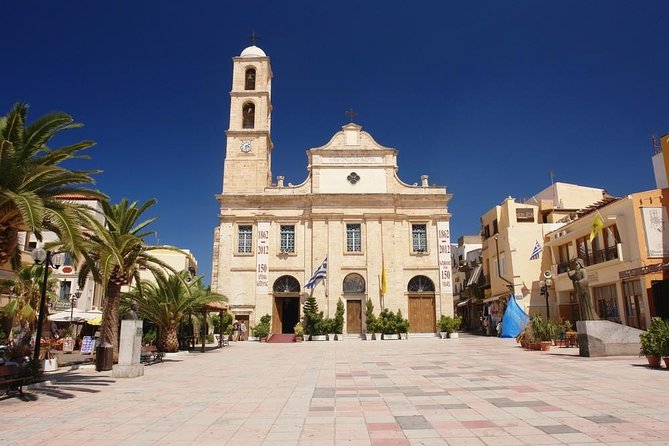
Your day begins with a drop-off at Talos Square on the west side of Chania Old Town. That’s not just a random point on the map—it’s a smart way to start. The western approach tends to feel less like a tourist funnel and more like you’re actually getting into the town’s rhythm.
From there, you’ll have time to walk the picturesque alleys at your own pace. The schedule describes about two hours of personal wandering in the old town area. That matters because Chania is the kind of place where the best moment might be a quiet courtyard, a church detail you notice because you slowed down, or a shop you’d never find if you stayed on a tight group route.
What you can do in that free time:
- Browse streets and small stores (yes, shopping is part of the day here)
- Stop for lunch if you’re hungry early
- Take photos without feeling rushed
Then the guide reconnects you (or you move as a group) toward the harbor-side highlights.
Expect walking. Review notes also flag that old town streets can be uneven with stairs, so if your group includes someone with mobility limits, tell the provider in advance. Private touring makes it easier to reduce stress by adjusting the walking route.
Old Venetian Harbor and the lighthouse pier: the view that earns the effort
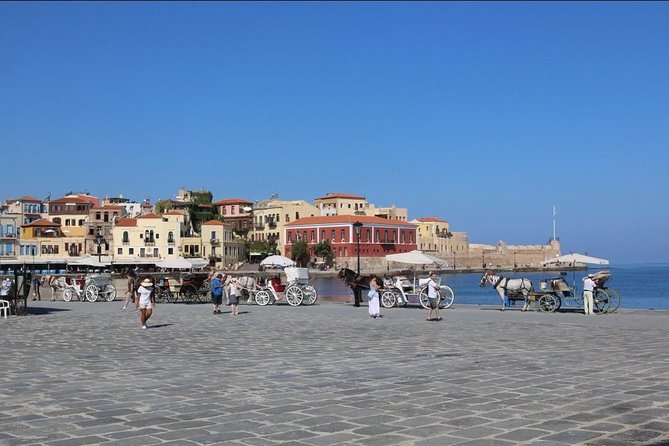
From the old town start, the harbor area is where Chania starts to feel cinematic. The harbor zone is a big chunk of the tour’s “wow” factor, and the schedule includes a stop focused on the Old Venetian Harbor area (with included admission).
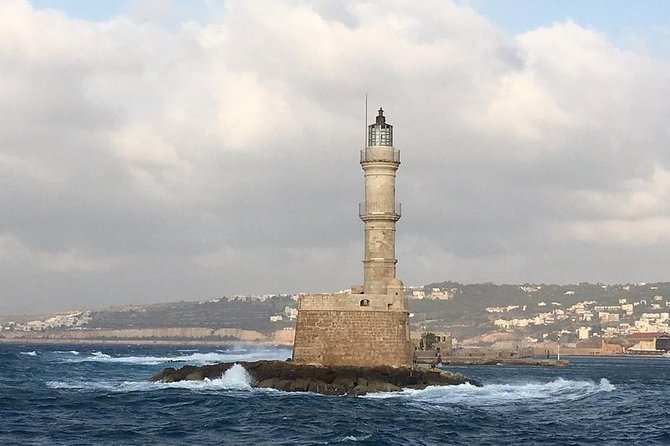
A short hop later is the Lighthouse of Chania, often described as the oldest lighthouse in the Mediterranean. Key details you’ll learn there:
- The lighthouse structure you see was built in 1864
- The tower is 21 meters tall, on a stone base
- It stands at the end of the old harbor’s pier, facing the Firkas Fortress
- You can’t go inside—the lighthouse is a landmark you view, not climb
- The story includes Venetian construction around 1600, a destruction during the siege of Chania, and later reshaping during Egyptian occupation, with restoration in 1996
The best part for your day? You get the context so you’re not just looking at a pretty tower—you understand what changed and why.
This is also where timing matters. The lighthouse stop is listed as brief (about 5 minutes). So treat it like a checkpoint: arrive, look, shoot your photos, and move on. If you want extra time here, ask your guide during the day.
Firka Fortress and Maritime Museum: a compact history stop
Next up is Firkas Fortress, on the northwest side of the port. This stop is short (listed around 5 minutes), but it hits a lot of history in a small space.
Here’s what the guide context can cover:
- Built between 1610 and 1645 to protect the Venetian harbor entrance
- After Ottoman control in 1645, it was renamed “Firka,” meaning barrack
- On the northern side, there were six domes that sheltered large cannons facing the harbor entrance
- Used as a prison and later tied to military governance
- The Greek flag was raised there in 1913, the year Crete reunited with Greece
- Today, the Maritime Museum sits at the fortress entrance, and its admission is listed as included
Even if you don’t go deep into museum rooms, the fortress area helps you read the port correctly. Once you understand it was a defensive gate to the harbor, you’ll notice how the waterfront is laid out for protection and control.
One caution: since the stop is brief, don’t expect to “museum binge.” If you love museums, consider going back on your own for a longer look.
Venetian Neoria shipyards: why you won’t enter (and still should stop)
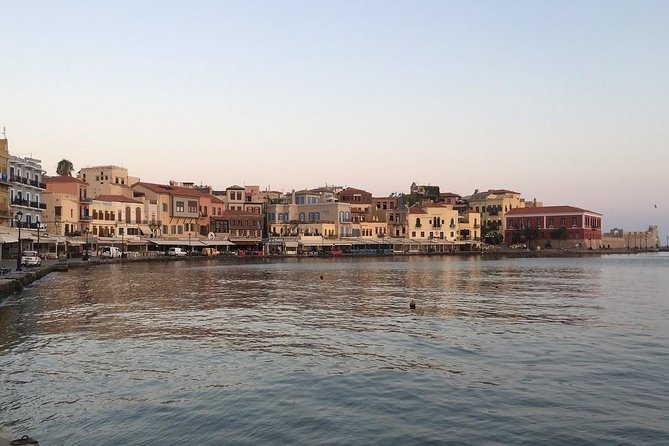
A quick stop follows at Venetian Neoria—the shipyards used during Venetian rule (1204–1669). You’ll hear that Venice ordered major construction in 1467, and that during Turkish rule the shipyards were converted into military warehouses.
What you see today:
- Seven shipyards survive
- Entrance isn’t allowed
So why include it at all? Because the ruins and layout help you understand Chania’s commercial and military importance. It turns the harbor from a pretty postcard into a working historical system.
This is another “look closely and move on” stop, listed at around 5 minutes. If you’re the type who hates short stops, you’ll want to balance the day with extra wandering time in the old town earlier.
Minoan Palace ruins at Kasteli hill: the ancient layer under the city
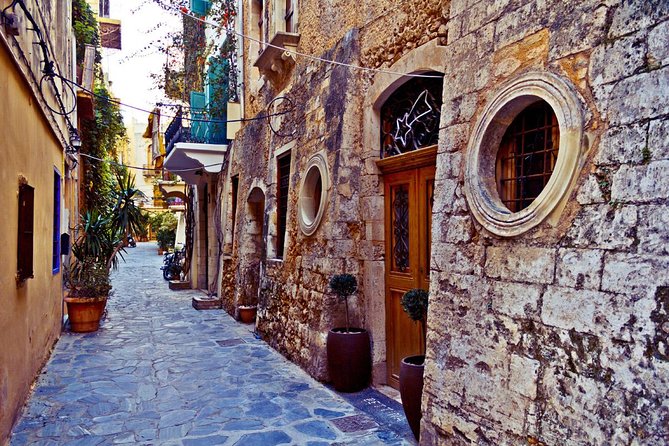
Chania is continuously inhabited for a very long time, and one of the tour’s points is to show you that the city has older roots than the Venetian and Ottoman layers.
The schedule includes a stop at the Minoan Palace ruins on Kasteli hill:
- Ongoing archaeological excavations unearthed foundations of buildings and streets
- The Minoan civilization dates before 3000 BC
- The tradition here notes a violent end around 1250 BC, connected to the Santorini eruption
This stop is brief (about 10 minutes), but it gives you a “oh wow” moment: you’re standing in a place where later civilizations built on earlier ones. The advantage is not the time—it’s the mental shift.
If you want a slower, deeper archaeological experience, this tour is still useful as a first pass. Then you can decide what to revisit on a future trip.
Souda port drive plus WWII cemetery and the views you’ll remember
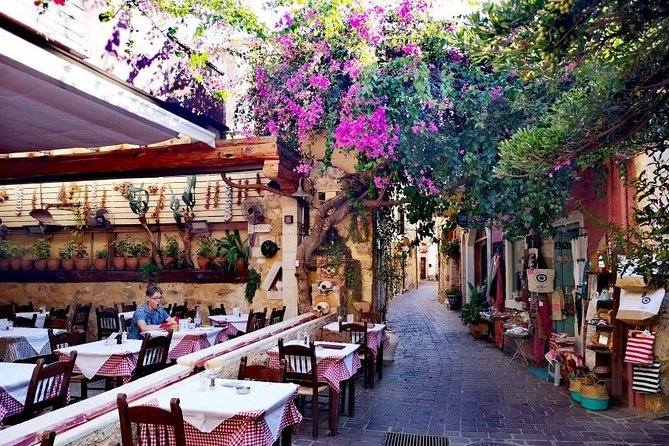
After the old town core, you shift gears. Souda is a short drive from Chania—listed as about 20 minutes one way—and the tour treats it like a mini shore excursion.
The most powerful stop here is the Souda Bay War Cemetery in the Commonwealth Cemetery area. You’ll learn:
- The cemetery includes mostly British, New Zealanders, and Australians buried there
- The Battle of Crete lasted May 20 to June 1, 1941
- It’s described as the first airborne-only operation in history
- The cemetery has panoramic views of Souda Bay and the White Mountains (Lefka Ori)
This is one of those stops where the short timing (about 20 minutes) works because the setting does a lot of the emotional heavy lifting. If you’re someone who likes to linger, you’ll probably want an extra few minutes, but you can at least step into the story and the view without a full museum schedule.
Venizelos Graves: a park viewpoint that caps the day nicely
The final major sight on the schedule is Venizelos Graves, described as more of a park than a monument-only stop.
You’ll get:
- A panoramic view over Chania town and the old port
- A calm end to a day that starts with alley walking and ends with open scenery
This stop is listed at about 20 minutes, which is enough to catch the view, take photos, and reset before returning.
If you’re booking this as part of a cruise day, that final viewpoint can be useful: it gives you a “big picture” orientation so you can understand where everything was back in the old town.
Lunch, tastings, and how to keep the day relaxed
Lunch is not included, but it’s clearly built into the optional cost: €25 per person for a local restaurant lunch.
What makes lunch choices easier with a guide is simple: you don’t have to gamble on where to eat when your feet are already tired. Many groups end up happier when they let the guide suggest a place and help with timing.
Also, there may be a small local tasting stop during the day—olive oil, honey, and other Cretan flavors show up in the experience based on guide-led interactions you might encounter. The key point for you: ask your guide what’s planned for food so you can decide if you’d rather shop, eat early, or save your appetite.
If your group wants to manage pacing, tell the guide early. In prior tours, guides have adjusted the day when guests needed it (especially for older adults dealing with stairs and blisters). The best version of this tour is the one where your needs become part of the route.
The guide factor: what George, Petros, Elsa, Zoe, and Peter bring
A private tour lives or dies by the guide’s ability to connect history to real life. And in the feedback for this experience, a theme shows up again and again: guides explain the “why” without turning your day into a lecture.
Some of the style notes you’ll likely notice:
- They answer questions and don’t just recite dates
- They talk about culture, traditions, and how daily life works in Crete
- They help with practical decisions during the free time in old town
You’ll also see a recurring praise for flexibility. One common example: if you’re with older adults or mobility-limited guests, the guide may reduce harder walking segments and keep the pace comfortable.
That doesn’t mean it’s effortless. Old town still has stairs. But it often means you won’t be forced down the hardest route if there’s a better alternative.
The one thing to watch: walking, timing, and brief stops
Let’s be honest. This tour includes walking on uneven streets and some stair-heavy old town areas. Even if the guide tries to manage it well, your shoes matter. Comfortable footwear is not optional here.
Timing is another consideration. The schedule includes a lot of highlights, but many of the landmark stops are short. So if you want deep time in one place (like the maritime side museum areas or extended ruins), you’ll likely need to plan extra time later on your own.
Finally, because it’s private, your day depends on how everyone in your group wants to move. One negative experience mentioned ending earlier than expected and feeling uncomfortable with certain choices. The takeaway for you: confirm what pacing and stops mean for your group when you start the day. Tell the guide upfront what matters most—old town wandering, harbor photos, WW2 cemetery time, or views.
Should you book this Chania private tour?
Book it if:
- You want a private, guide-led Chania day with real context (not just a quick drive-by)
- Your group is 2–6 people and you’ll benefit from having control over the pace
- WWII history, Venetian harbor layers, and Cretan timelines appeal to you
- You’d like a day plan that includes time to wander on your own in Old Town
Skip it (or ask for adjustments) if:
- Your group needs a low-walking day with no stairs at all
- You hate short stops and prefer fewer locations with longer stays
- You’re extremely sensitive to uneven pavement and hills
My honest call: if you come to Chania for the streets and the stories behind the harbor, this private format is a strong value. The best results come when you tell your guide how you want the day to feel—easy, historic, food-focused, photo-driven—and then let them steer that flexible plan.
FAQ
How many people is this private tour for?
It’s a private tour for your group, with a price listed per group of up to 6 people.
What’s the tour duration?
The tour is listed as about 5 to 6 hours.
Where do we get picked up?
Pickup and drop-off are offered at Souda port, your accommodation, or any convenient location within about 10 km (6 miles) around Chania old town.
Is the tour in English?
Yes, the tour is offered in English.
Are entrance tickets included?
Most listed stops are free. Admission is included for the Old Venetian Harbor area and for the Firka Fortress stop (Maritime Museum at the entrance). The lighthouse and Venetian Neoria areas are described as not allowing entry.
Does lunch cost extra?
Yes. Lunch is optional and listed as €25 per person at a local restaurant.
Are there optional add-ons?
Yes. There are optional extras such as €25 for wine tasting, plus optional add-ons that include extra drive time with lunch (listed as €150 total for 3 hours for mountain driving, or €150 total for 3 hours for a beach option).
What happens if the weather is bad?
The experience requires good weather. If it’s canceled due to poor weather, you’ll be offered a different date or a full refund.
More Tour Reviews in Chania
More of Chania Old Town


Fresh Off the Boat: Newest Crete Reviews

Chania Old Town, compared.
 ★ 4.4From Heraklion: Cruise to Balos Lagoon and Chania Old TownFrom $88526 reviews
 ★ 4.9Chania: Old Town Highlights Guided Tour with Street FoodFrom $106407 reviews
 ★ 5.0Walking “Food tasting tour” in the town of ChaniaFrom $105297 reviews
 ★ 4.7Chania: 7 Villages of Apokoronas Tour with LunchFrom $135289 reviews
 ★ 4.5From Heraklion: Chania Town, Kournas Lake, and Rethymno TourFrom $56288 reviews
 ★ 4.8Chania Town: Glass-Bottom Boat Cruise to Thodorou & LazaretaFrom $53285 reviews
 ★ 5.0The 7 Villages of Apokoronas Tour – Explore East Chania MainlandFrom $139178 reviews
 ★ 4.9Chania Old Port:Luxury Sunset Catamaran Cruise with ProseccoFrom $100177 reviews
Browse the lists this tour appears in